Where it all began: creating Romeo & Juliet in 1977 – part 1

Frederic Jahn-Werner
Danced Tybalt on opening night.
Staged the production for Paris Opera Ballet and other companies for over 35 years, alongside Patricia Ruanne (who originated the role of Juliet).
“At the start of the rehearsal period, the Company did not have a permanent home yet, so the first rehearsals took place in the famous Donmar studios, now known as the Donmar Warehouse, before moving to our new home in Kensington.
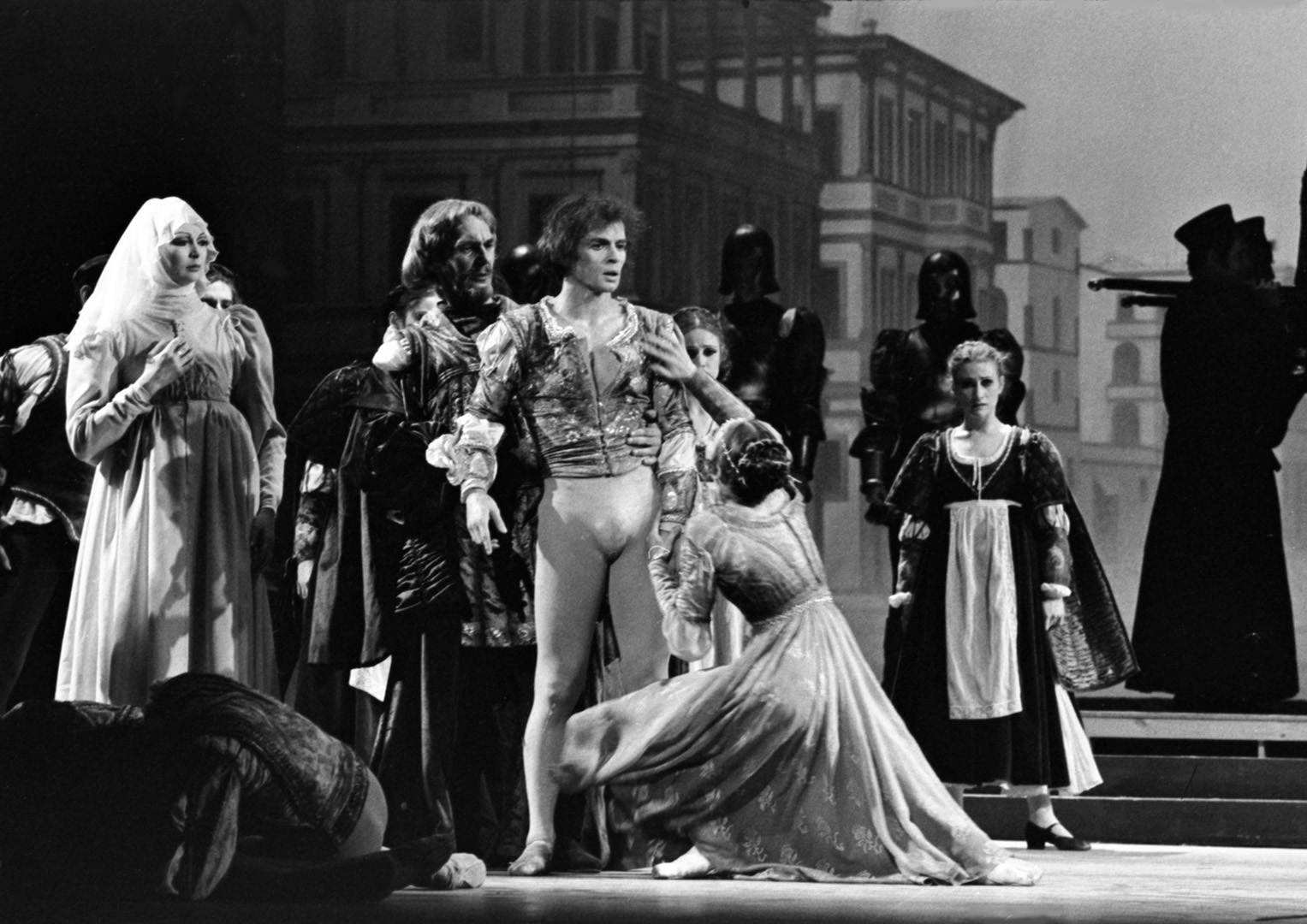
During the day, Rudolf Nureyev was unavailable due to his filming schedule for the film Valentino, and the Company was rehearsing other ballets, preparing for the London Coliseum season happening in spring 1977. So the first rehearsals would begin at seven o’clock in the evening. About six dancers – Patricia Ruanne, Nicholas Johnson, Jonas Kåge, Elizabeth Anderton (our ballet mistress), Alain Dubreuil, and myself – were asked to stay late to work on sequences with Mr. Nureyev, who we all called Rudi.
Rudolf focused on choreographing dance sequences and mime scenes. Except for Betty Anderton (who would be the Nurse), none of us initially knew which characters we would portray. For example, I shifted between roles, including Paris, Tybalt, Friar Lawrence, and Lord Capulet. Those frequent changes gave us insight into the depth and ambition of the production.
Thanks to his generosity, we were given the freedom to explore and shape our own interpretations within the framework of each character. I was fortunate to be cast as Tybalt, a role I regarded as a true privilege. I deliberately moved away from the traditional portrayal of an “ancient grudge with a blade” and instead chose to depict him as a mature teenager, bringing a fresh perspective to the role.”
“This creative approach extended to the corps de ballet as well. To capture an authentic Veronian feel, Rudi demonstrated a step once, and the dancers picked it up and amplified it just as he wanted. When the cruder moments in the first act came up, there was no hesitation in performing them. Rudolf made sure everything was clear, especially the gestures, stressing that the audience must always understand what’s happening on stage.
Rudi was compassionate, he clearly understood we were doing things we were not used to: dancing with flags, dancing with mandolins, fighting and dancing with weapons, and for the girls, the length and weight of their ball gowns made moving as big as he required extremely difficult. He was therefore very patient and helped as much as possible explaining what they had to do to make it work. When he gave a correction, there would often be a silly joke made to ease the dancer, which definitely created an agreeable atmosphere in the studio. In general I found him extremely calm considering the task he had in front of him: he created that massive production in just a few weeks.
On opening night on 2 June, there was a lot of energy on stage as the dancers ran through their steps. You could hear the buzz from the audience through the thick curtain of the Coliseum. Rudolf, as always, was carefully going over all his variations, occasionally stopping to discuss production details with Patricia Ruanne, who was dancing Juliet. After all the work to bring the production to the stage, it was a relief to finally perform it. The opening party took place at the Savoy Hotel on the Strand. By the time Patricia was ready, after numerous curtain calls, it was nearly midnight. As she entered the ballroom, I let her take her moment and walk to her table where Rudolf was seated. When the applause ended, the 250 guests and dancers sang happy birthday – Patricia had turned 32 on 3 June.”
Janette Mulligan
Danced in the corps de ballet on opening night.
The Australian-born ballerina danced with London Festival Ballet from 1977 – 1990, rising to the rank of Senior Principal.
“In January 1977, Beryl Grey (then Artistic Director of London Festival Ballet) held a big audition at the Royal Festival Hall in London. We called it the cattle market as there were nearly 200 of us auditioning. She was building the Company numbers ready for Rudi’s production. I was offered a 2nd year artist contract (along with New Zealander Sheryl Stone). I had no idea what the repertoire for the year was going to be: don’t forget there were no mobile phones and we got paid in cash in little brown envelopes every fortnight!
It feels like only yesterday we had just finished the spring tour and moved into our new home on Jay Mews, in South Kensington, for the very first time. The schedule was pretty tight, with rehearsals until 9pm for the corps de ballet (and later for the Principals), including a lunch and a tea break. We had to be there and wait to be called.”
“I don’t remember there being a casting as such. The members of the corps were just informed as rehearsals progressed. When Rudi started choregraphing the Montague Servants I was very happy I was cast as one of them. I just loved it as there is so much rhythm to it and a lot of fun! I could still do it now and teach it: being an original it’s very hard to forget the steps you help create. I was also to do walk overs and back flips in my character so I guess my contribution to the choreography was unique.
The fight scenes were amazing to watch being created. Rudi knew he didn’t want swords clashing on the music as in other productions, so a fight instructor from the film industry, B.H. Barry, was brought in. I enjoyed the rehearsal period even though the days were long – it was exciting. We came in one day and discovered one of the mirrors had been broken in the corner. Apparently, the night before the Principal dancers were wanting to call it a day (probably at midnight) and Rudi got frustrated and threw one of his clogs.
Our Ballet Mistress Elizabeth Anderton (Betty) was incredible. She was by Rudi’s side the whole time: organising rehearsals, keeping everyone informed, making sure everyone was ready whenever Rudi wanted to do a scene… She was also Juliet’s nurse and she was brilliant.
Opening night arrived and took place without a hitch, from my memory – only long intervals, partly because Rudi always wanted to practice his solos before the curtain went up. I danced as a Montague Servant and Lady in the Ballroom scene, so I had a quick change which is always fun. In Act 2, after the Ball, the Montague Ladies would sit on the rostrum and wait, watching the dancing – including Romeo’s. In the first week, Rudi came up to us and asked us if we preferred the white tights or the green: I told him I preferred the white as the green him made him look like he had frogs’ legs! The Romeos continue to wear white tights today.
We did a 3-week season, without much movement in casting unless someone was injured or sick. It enabled us to take risks and develop our characters. We never got bored of doing it. Rudi’s Romeo & Juliet remains exceptional.”

Nigel Burgoine
Danced in the corps de ballet on opening night.
Dancer with London Festival Ballet, 1972 – 1985.
“I had joined the company in 1972, so I had worked with Nureyev when he did Sleeping Beauty for us in 1975. That production had been very much about him dancing, and we had spent most of the ballet standing in the back in beautiful costumes. So when Beryl Grey, our Artistic Director, announced that he would do Romeo & Juliet, I thought “Are we going to be standing around all the time?” – but no, he really used all the Company for this production.
We had just moved from Donmar Studios to our own building over at Jay Mews in Kensington. Rudi came in and it was amazing. We would do class and then we had to sit all day in the studio, watching the rehearsals – even if it was just a pas de deux or a solo – until he’d say “I want to do this scene now” and you had to get up and try to warm up quickly, when you had barely moved for hours! Later in the process he would have us run the ballet again and again.
Rudi was quite collaborative: he would choreograph a step, then do another one and then he’d say to us “what do you like best?” – that wasn’t what he was like before. He also had the idea of doing a flag dance, which he had taken from the famous horse race in Siena. We got some flags and I was playing around (putting it under my legs, things like that), he was looking and went “Okay good we keep this!”. My colleagues humoured me: “What other steps are you going to create for us, Nigel?”
We also got involved with the fight scenes: we told him it felt too balletic, “can we do this instead, flip here, jump on each other?” and he was responsive. We’d all been to school together and knew each other well, so we would work on stuff ourselves, and then with him. It was such a different thing for us: we had to step into a fight scene – a smack in the face here, a banging in the crotch there – and not a chassé-pas de bourrée-glissade-assemblé!”
“He was a big star. Someone came to interview him and they had all these lights on him and suddenly all the lights went out: they’d blown the fuses! Rudi complained to Beryl “it’s your stupid building” and she responded “it’s your stupid interview!”
He was also temperamental. One of the things I remember the most was that, at the beginning, there was this enormous boat that came on at the back of the stage, showing the market traders coming off with all their goods. After seeing how it looked and moved on stage, Rudi said “Cut!”. This piece of set was huge! The stage crew ended up making beds and furniture out of it. He argued with Ezio Frigerio, the designer – on opening night I found Ezio backstage in wardrobe reading the newspaper. He was so nervous he wouldn’t go and watch the show.
At the premiere I danced one of the fighting Montagues and then I was the lead flag dancer. Opening night was wonderful. Everyone had worked very hard to make this a great success. The production is so special, and I have so many memories of my time in it.”
Fifty years on, English National Ballet continues to perform Nureyev’s iconic production.
See it on tour in Liverpool, Manchester, Southampton and London this autumn/winter.
Related news

Creating a Classic: Nureyev’s Romeo & Juliet
Nearly five decades on, Rudolf Nureyev's Romeo & Juliet remains one of ballet's most daring interpretations of Shakespeare's tragedy. Here's...

Romeo and Juliet: the pop culture blueprint for star-crossed lovers
As English National Ballet returns this autumn with Rudolf Nureyev’s iconic ballet, here’s a roundup of the quintessential Romeo &...

Nureyev101: Getting to know Rudolf Nureyev
As we perform one of the legendary dancer and choreographer’s celebrated works, we take a look at Rudolf Nureyev’s legacy...

Five things you may not know about Nureyev’s Romeo & Juliet
In 1977, the legendary Rudolf Nureyev created his own version of the ballet Romeo & Juliet for us.
Five of the most challenging roles for male dancers
Learn more about five of the most challenging male ballet roles - they all are a must-watch for ballet fans.
5 of the most challenging roles for female ballet dancers
We explore five of the most challenging lead roles for female ballet dancers in the classical repertoire.