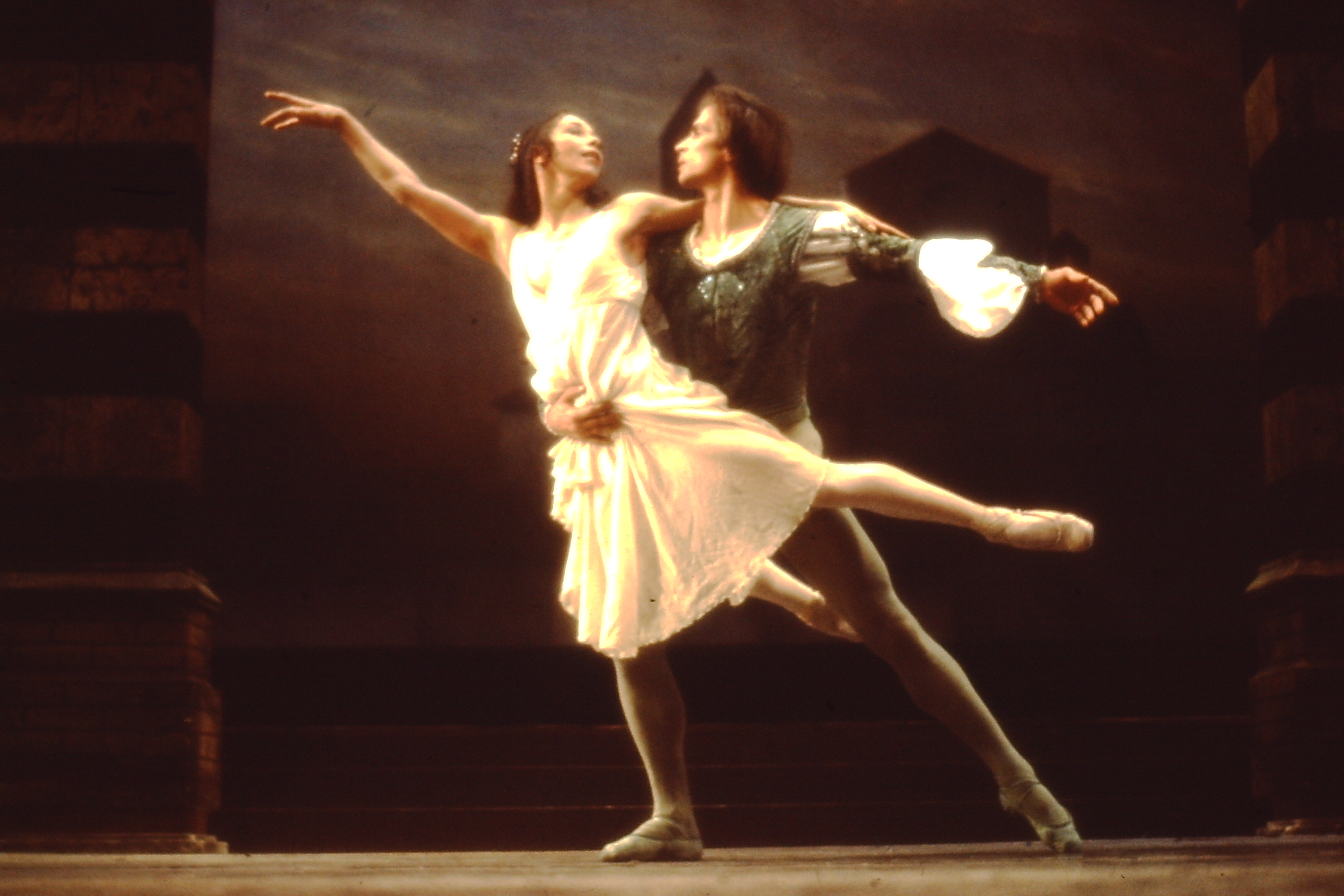
Creating a Classic: Nureyev’s Romeo & Juliet
This autumn, English National Ballet tours the production nationally. Here's how it came to be.
Surprisingly, ballet took a long time to embrace one of literature’s greatest love stories. Despite its obvious romantic and dramatic potential, very few choreographers attempted to stage Romeo & Juliet before the 20th century. It wasn’t until composer Sergei Prokofiev entered the picture that the story truly found its place on the ballet stage. This is where our story begins.
A score that almost never made it to the stage
In 1934, the Kirov Ballet (now Mariinsky Ballet) commissioned Sergei Prokofiev to compose a score for Romeo & Juliet – a chance for the composer, who’d spent years abroad, to reconnect with his Russian roots. He worked closely from Shakespeare’s text, giving each character their own musical theme.
But the Kirov Ballet had doubts the story’s complexity could work in a dance format, and shelved the project in 1935. The Bolshoi rejected it too, calling the score “undanceable.” It would take a small company in Czechoslovakia, Brno Ballet, to finally stage the world premiere in 1938. Only after its success did the Kirov reconsider, finally performing it in Leningrad in 1940.

A ballet created against the clock
Fast forward to 1965 when the Royal Ballet premiered their version of Romeo & Juliet, choreographed by Kenneth MacMillan; dancing Romeo was none other than Rudolf Nureyev.
Twelve years later, in 1977, Nureyev was invited to choreograph his own take on Romeo & Juliet for London Festival Ballet, as part of Queen Elizabeth II’s Silver Jubilee. His interpretation would be something very different.
Nureyev initially considered setting his production to authentic 13th and 14th-century music, before deciding against it – worried, in his own words, that two hours of it in the theatre might prove tiresome for audiences. He settled instead on Prokofiev’s now-iconic score.
Choreographing the ballet was no easy feat. Nureyev was juggling filming Ken Russell’s Valentino alongside dance engagements with the Royal Ballet, Royal Danish Ballet and Martha Graham’s company. For the ballet’s dramatic fight scenes, he brought in fight director B.H. Barry, known for his work with the Royal Shakespeare Company and numerous Hollywood productions. Rehearsals were fast – as Nureyev only had a few weeks to put the ballet together, scenery for the London Coliseum premiere arrived late, and the ballet’s devastating final scene was never fully rehearsed before opening night. For all the complications, the performance was a triumph and the premiere was met with huge acclaim.
Despite my fears, the public loved the ballet and gave Nureyev a great ovation which lasted a long time while I was taking Princess Margaret backstage. – Excerpt taken from Dame Beryl Grey’s (Artistic Director 1968-79) autobiography For the Love of Dance

So what makes Nureyev’s ballet so different?
Where other productions lean into romance and lyricism, Nureyev wanted something rawer. He sought to portray a Renaissance society, marked by violence, danger and disorder.
Nureyev tended to put you more at risk. He felt that each performance required a dancer to cross a personal barrier of skill and endurance, and certainly I never felt I had every aspect of the ballet under complete physical and emotional control. However, I realized that this feeling of being faintly panic-stricken by the uncertainty of controlling events was, in his mind, the key to how Romeo and Juliet would have felt. All that remained was to accept and make use of the sensation within the production. – Patricia Ruanne, original Juliet (1977)
Nureyev studied Shakespeare’s text closely, and his version is a very close ballet adaptation to the original play. Specific details call back to the actual text – for example when Juliet is lying in her bed beside a skeletal figure representing Death (“Come nurse, I’ll to my wedding bed; and Death, not Romeo, take my maidenhead!”)
His choreography borrowed from cinema and modern dance alike to convey the drama: freeze-frame moments capture Juliet’s shock and inner turmoil, while visions and fantasy sequences blur the line between reality and imagination. Touches of Martha Graham technique appear in the wedding scene, while the street brawls carry an echo of Jerome Robbins’ West Side Story.
A legacy that endures
After its premiere with London Festival Ballet – now, us, English National Ballet – at the London Coliseum on 2 June 1977, Nureyev went on to stage further versions with La Scala Ballet in Milan (1980) and the Paris Opera Ballet (1984), each production danced by celebrated casts including Carla Fracci and Sylvie Guillem as Juliet, and Margot Fonteyn as Lady Capulet.
Created nearly fifty years ago, Nureyev’s Romeo & Juliet remains a defining piece in our history and our repertoire. This autumn 2026, audiences around the country will have the chance to experience it once again.
Learn more about Nureyev’s extraordinary life and legacy on the Rudolf Nureyev Foundation website.
We’re performing Romeo & Juliet at the Liverpool Empire (15 – 17 Oct), Palace Theatre Manchester (21 – 25 Oct), Mayflower Theatre in Southampton (3 – 5 Dec) and London Coliseum (14 – 24 Jan). Book your tickets now.
Production Sponsor

Related news

Romeo and Juliet: the pop culture blueprint for star-crossed lovers
As English National Ballet returns this autumn with Rudolf Nureyev’s iconic ballet, here’s a roundup of the quintessential Romeo &...

Nureyev101: Getting to know Rudolf Nureyev
As we perform one of the legendary dancer and choreographer’s celebrated works, we take a look at Rudolf Nureyev’s legacy...

Five things you may not know about Nureyev’s Romeo & Juliet
In 1977, the legendary Rudolf Nureyev created his own version of the ballet Romeo & Juliet for us.
Five of the most challenging roles for male dancers
Learn more about five of the most challenging male ballet roles - they all are a must-watch for ballet fans.
5 of the most challenging roles for female ballet dancers
We explore five of the most challenging lead roles for female ballet dancers in the classical repertoire.
Five ballets that will break your heart
Which ballets are the most likely to bring audiences to tears?