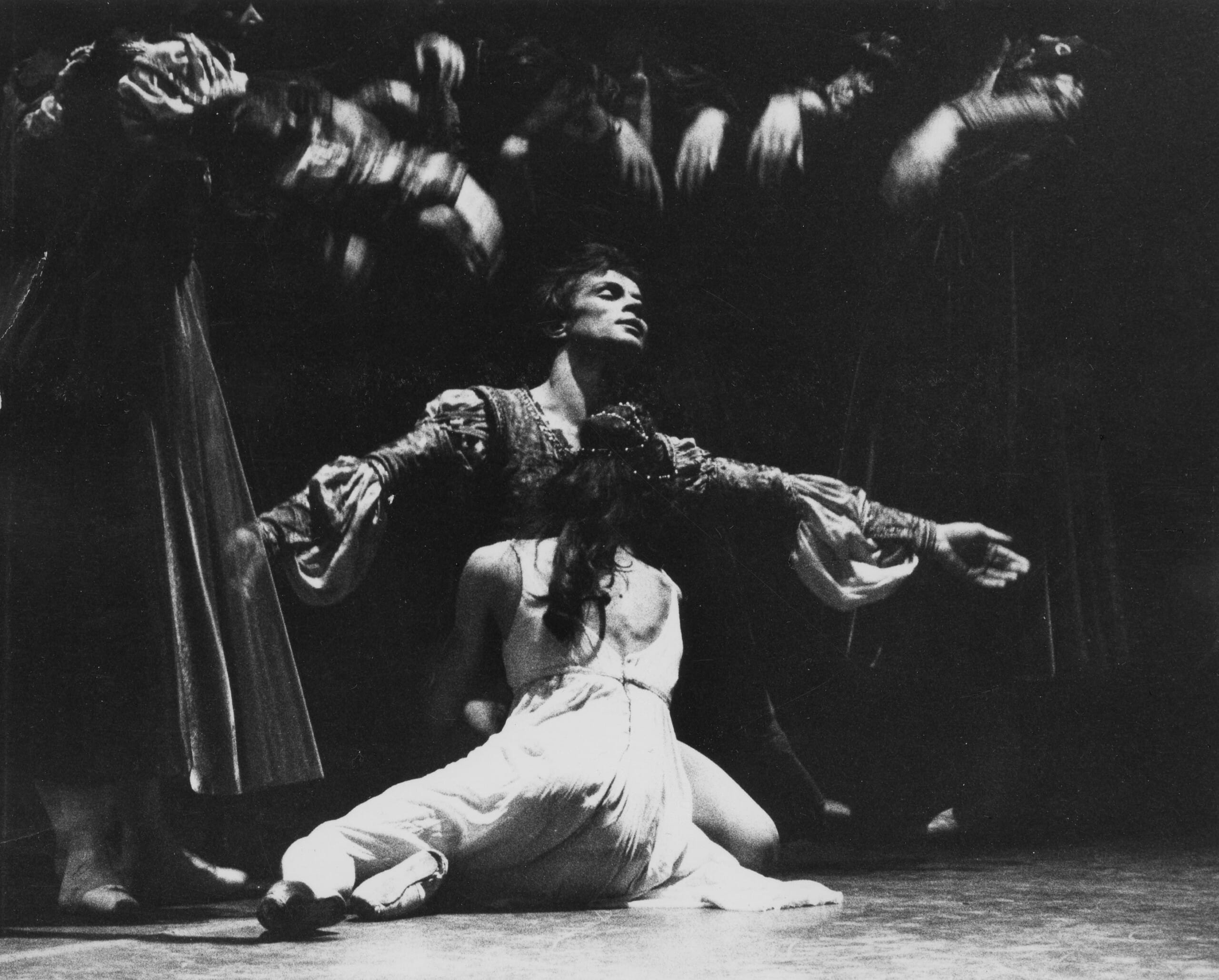
Nureyev101: Getting to know Rudolf Nureyev
This autumn, English National Ballet bring Rudolf Nureyev’s Romeo & Juliet to stages across the country. As we perform one of the legendary dancer and choreographer’s celebrated works, we take a look at Rudolf Nureyev’s legacy and how he continues to shape the artform today.
Rudolf Nureyev: finding his feet
The youngest of four children in a Tatar family, Rudolf Nureyev had a dramatic start to life. He was born on a train on 17 March 1938. He saw his first ballet performance at the age of 11 – a moment which ignited his passion for dance. However, due to the disruption of World War II, he had a notably late start to his training which didn’t begin until he was aged 17 (in 1955).
This marked the start of an extraordinary career.
After being accepted into the Vaganova Academy in Leningrad, ballet master Alexander Pushkin saw something special in Nureyev. So much so, he invited him to live with his family. Nureyev graduated in 1958 and joined the Kirov Ballet, skipping the corps de ballet entirely to join the company as a Principal from day one.

International stardom
After dancing with the company for three years, there came a moment that changed everything. In 1961, while on tour in Paris, Nureyev defected to the West – the first Soviet artist to do so during the Cold War, sending shockwaves through the world stage. As the Kirov Ballet (now The Mariinsky Ballet) were waiting for their flight at Le Bourget airport, Nureyev approached French officials and famously said “I want to stay and to be free”.
Within days he was dancing with the Grand Ballet du Marquis de Cuevas in Europe, and by 1962, he’d found his most iconic partner: Dame Margot Fonteyn, with whom he danced Giselle at the Royal Opera House.This performance marked the beginning of his long association with the Royal Ballet where he became a permanent guest artist and showcased his exceptional talent for 20 years. It was here that he really established his reputation. Nureyev became known for his flamboyant style, electric stage presence, soaring leaps, and rapid turns – performing with a virtuosity rarely seen before.
He made his American debut in 1962, appearing on American television with Ruth Page’s Chicago Opera Ballet and went on to become famous around the world. Bringing drama and psychological depth to every performance, it’s said that he also lived his personal life with the same intensity and passion.

A dancer, choreographer and artistic director
Nureyev’s brilliance extended far beyond performance. He choreographed acclaimed new versions of Romeo and Juliet, The Sleeping Beauty and The Nutcracker, as well as reworking Swan Lake in Vienna in 1964, giving the male dancer a far more prominent role than had traditionally been the case.
In 1977, London Festival Ballet – now English National Ballet – commissioned his production of Romeo and Juliet, set to Sergei Prokofiev’s score. The production remains one of our most treasured works.
…is very different from its predecessors and is absolutely fascinating. It is fresh and original, and considering [it’s] the first time he has created a completely original ballet on such a scale, the certainty of the achievement is all the more remarkable. – The New York Times, June 1977
From 1983 to 1989, Nureyev served as Artistic Director of the Paris Opéra Ballet, revitalising the company and mentoring a new generation of dancers.
His legacy
Nureyev’s influence on ballet was profound. Before him, the male dancer was frequently secondary to the ballerina; after him, male dancers were recognised as equal artistic forces on stage.
His talent as a dancer wasn’t just confined to the classics. Nureyev also embraced modern dance, performing works choreographed by Martha Graham herself, including Night Journey and Lucifer, demonstrating what was, at the time, a rare willingness to move fluidly between classical and contemporary worlds.
As for his choreography, it was Nureyev’s ability to create equally rich and demanding choreography for the ensemble that really set him apart. This was a skill he taught himself through close study of Petipa’s work and one that is a hallmark of his choreographic mastery.
Nureyev passed away in Paris on 6 January 1993, but his dance technique, performances and choreography continue to inspire dancers and companies around the world, including our own. His enduring legacy is a lasting testament to a dancer and choreographer who redefined what ballet could be.
…The main thing is dancing, and before it withers away from my body, I will keep dancing till the last moment, the last drop. – Rudolph Nureyev
Learn more about Nureyev’s extraordinary life and legacy on the Rudolf Nureyev Foundation website.
We’re performing Romeo & Juliet at the Liverpool Empire (15 – 17 Oct), Palace Theatre Manchester (21 – 25 Oct), Mayflower Theatre in Southampton (3 – 5 Dec) and London Coliseum (14 – 24 Jan). Book your tickets now.
Production Sponsor

Related news

Creating a Classic: Nureyev’s Romeo & Juliet
Nearly five decades on, Rudolf Nureyev's Romeo & Juliet remains one of ballet's most daring interpretations of Shakespeare's tragedy. Here's...

Romeo and Juliet: the pop culture blueprint for star-crossed lovers
As English National Ballet returns this autumn with Rudolf Nureyev’s iconic ballet, here’s a roundup of the quintessential Romeo &...

Five things you may not know about Nureyev’s Romeo & Juliet
In 1977, the legendary Rudolf Nureyev created his own version of the ballet Romeo & Juliet for us.
Five of the most challenging roles for male dancers
Learn more about five of the most challenging male ballet roles - they all are a must-watch for ballet fans.
5 of the most challenging roles for female ballet dancers
We explore five of the most challenging lead roles for female ballet dancers in the classical repertoire.
Five ballets that will break your heart
Which ballets are the most likely to bring audiences to tears?