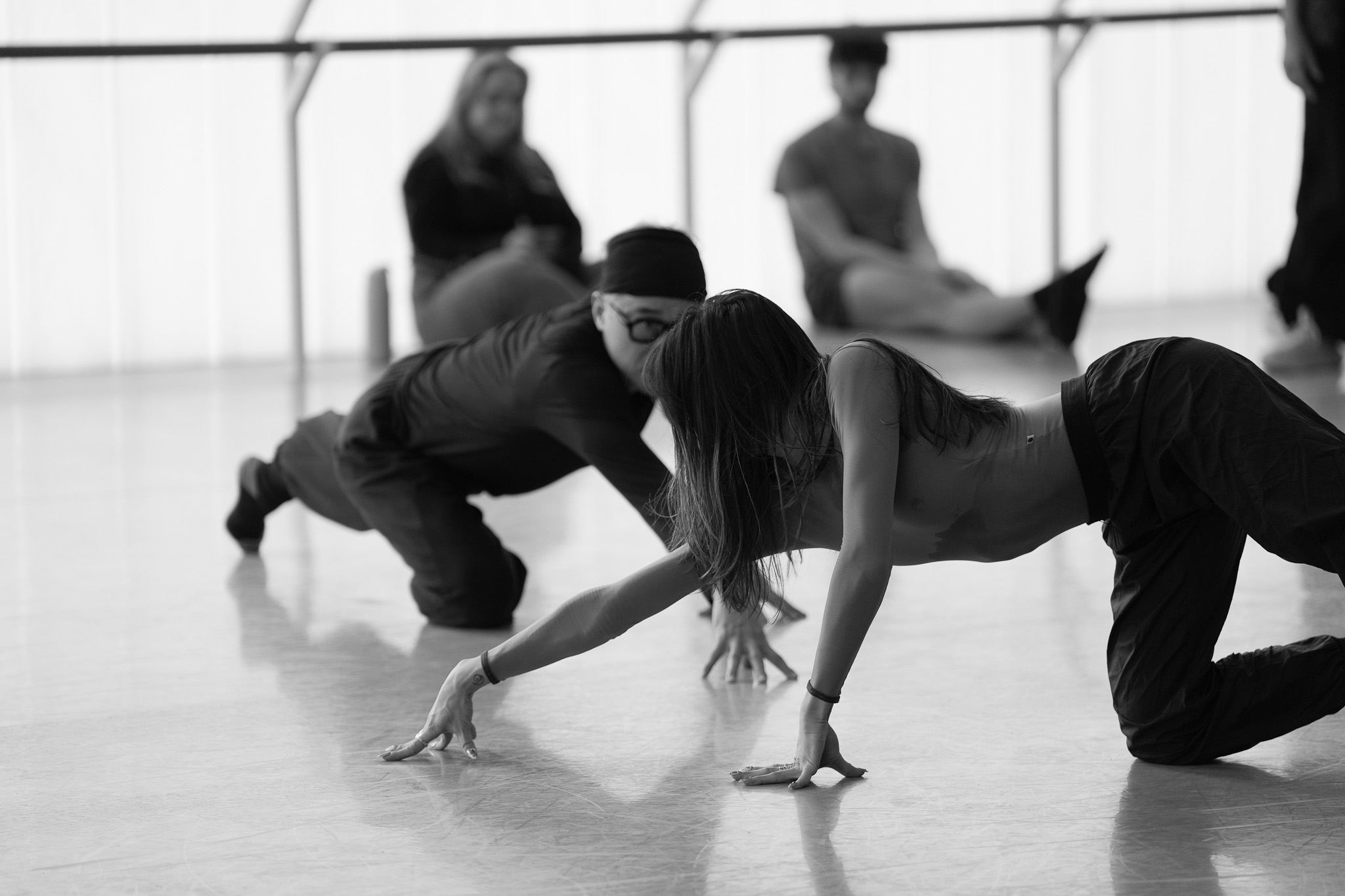
Auguries of Innocence: Everything to know about Jae Man Joo’s world premiere
Ahead of opening night, discover the inspiration, artistry and emotion behind this powerful new piece.
1. Jae Man Joo’s choreographic voice
Choreography first became central to Jae Man Joo’s creative identity when he was appointed resident choreographer at Complexions Contemporary Ballet in New York City, an opportunity offered to him by director Dwight Rhoden.
But it was a trip to Paris – and a performance of Pina Bausch’s Nelken – that truly shaped his artistic direction. Joo describes the piece as pure and joyful, yet deeply painful, capturing a vast range of human emotion. It was this experience that pushed him to explore his own identity as a choreographer.
Trained in both classical ballet and Korean traditional dance, Joo brings a distinctive movement language to Auguries of Innocence. He describes his style as rooted in breath control, drawing on human emotion, and the spirit of Korean traditional dance.
I love the intricate detail of upper torso movement, breath control, and the spirit of traditional Korean dance, movement that blends classical technique and dancer’s beautiful lines, like a moving sculpture. – Jae Man Joo, Choreographer
2. William Blake: where it all began
Auguries of Innocence takes its inspiration from the poem of the same name by William Blake – a work that captures, in Joo’s words, the deep connection between nature and humanity.
The poem is believed to have been written in 1803, though it wasn’t published until decades later, in 1863, as part of Blake’s biography. Spanning 132 lines, the poem weaves together a series of striking paradoxes – innocence set against evil, purity against corruption – with ‘augury’ itself referring to a sign or omen of what’s to come.
Its opening lines remain some of the most quoted in English poetry, capturing vast, universal ideas within small, everyday images:
“To see a World in a Grain of Sand
And a Heaven in a Wild Flower
Hold Infinity in the palm of your hand
And Eternity in an hour.”
I feel this poem reflects what we are living through right now. His words are vivid and uncompromising, powerful, symbolic, highly critical, calling out cruelty, corruption. My ballet is a response to that call. – Jae Man Joo, Choreographer
3. Pēteris Vasks: a driving force of emotion
The music for Auguries of Innocence brings together two orchestral works by Latvian composer Pēteris Vasks: Musica Dolorosa and Musica Serena. For Joo, the score wasn’t just a backdrop – it became a driving force behind the piece itself, shaping its emotional core from the very beginning.
The searing score for Auguries of Innocence will be performed live by English National Ballet Philharmonic.
I am extremely inspired by Pēteris Vasks’ music. When I listen to it, I hear nature crying out, mourning what humanity has lost. This is why his music is so important for this work. – Jae Man Joo, Choreographer
Alongside this, you can also listen for a moment where you’ll hear an excerpt of Korean drumming. Venerable Gogeum Sunim is a highly revered Korean Buddhist monk widely celebrated for his masterful and dynamic performances of Beopgogongyang (Dharma drum offering). Played as a recorded interlude, the Beopgogongyang drum music is a powerful striking rhythm, intensifying the drama of the piece.

4. The hidden secret in 20,000 brushstrokes
Set and costume designer Thomas Mika worked closely with Jae Man Joo to bring Auguries of Innocence to life visually. The pair first connected on social media a few years ago and have waited for the right project to collaborate on.
When discussing the potential direction for the piece, Joo arrived with a clear vision – mood boards, the poem itself, and the music that would accompany the choreography. All of this was extremely helpful in shaping Mika’s design process from the outset.
The set takes the form of a “lost space”: four large, broken walls covered in over 20,000 individually placed brushstroke lines, designed to evoke years of wear, as though the dancers themselves have painted them over time.
Watch out for a small secret hidden within the brushstrokes – one that only reveals itself as the ballet reaches its final moment.
5. Mother Earth reimagined
At the centre of the piece is the Weaver of Souls, a figure who connects all three sections of the ballet, performed here by dancers Sangeun Lee and Jakob Wheway Hughes. The costume is designed as an inverted tree – built from a mix of leather, ribbon, and multiple layered fabrics to create an organic, almost weathered texture.
The torso being the stem of the tree and then it branches out to the ground like a transformative figure on stage – Thomas Mika, Set and Costume designer
Bringing the costumes and set to life has been a truly collaborative effort, spanning four different workshops. Set construction was handled by Bay Productions in Wales, while the costumes themselves were split across specialist teams. One team dedicated to leotards and stretch fabrics, another to trousers, and a third to leatherwork – with the Weaver of Souls costume created in-house by English National Ballet’s own costume team.
We’re performing the world premiere of Auguries of Innocence as part of Rhythm Riot at Sadler’s Wells, 24 Sept – 3 Oct. This ballet will be performed alongside the world premiere of Micaela Taylor’s Bow Out and George Balanchine’s Symphony in Three Movements. Book your tickets.
Related news


Introducing Micaela Taylor
Aaron S. Watkin talks about the LA-based choreographer and the essence of her new work, Bow Out.

5 things you didn’t know about George Balanchine’s Symphony in Three Movements
As we prepare to showcase Symphony in Three Movements in September, here are five things you might not know about...

5 things to look out for in Bow Out
Fresh, bold, and full of infectious energy - here are 5 things to watch out for in Bow Out by...

Introducing Symphony in Three Movements
Aaron S. Watkin reveals what is so special about Balanchine's masterpiece.