5 things you didn’t know about George Balanchine’s Symphony in Three Movements
1. Music shapes every step we see
Long before he became one of the twentieth century’s most influential choreographers, George Balanchine was immersed in the world of music. Born into a musical family (his father was a composer, and his brother Andria would go on to become one, too) Balanchine started learning piano at just five years old.
After his ballet training at the Imperial Ballet School, St Petersburg, he enrolled at the Petrograd Conservatory of Music. There he spent three years mastering piano, harmony, counterpoint and composition. This wasn’t just a side interest – it gave him a rare fluency in music that is evident in his choreography.
His ability to reduce full orchestral scores at the piano, allowed him to work hand-in-hand with composers of the highest calibre, including Igor Stravinsky (one of the most important and influential composers of the 20th century). He didn’t just choreograph to music, he spoke its language fluently.

2. A tribute that became a creative explosion
During his career, Balanchine collaborated with Stravinsky many times. To honour his longtime friend after death, Balanchine dedicated an entire week to celebrating Igor Stravinsky’s music. From 18-25 June 1972, New York City Ballet’s New York State Theatre became the stage for the Stravinsky Festival. This was a whirlwind celebration featuring 22 world premieres, seven of which were choreographed by Balanchine himself. It was more than a tribute, it was a meeting of two creative minds.
Among the new works was Symphony in Three Movements, set to sections of scores Stravinsky had composed during the Second World War for film projects that never came to be.
Stravinsky, gave us…such a fantastic avalanche of sound…how could he do it? Not only that, if you see how it’s written, you see how many notes there are and when you hear, you think my god he had to do that all by hand. You know…if I had to copy his music I would probably need 200 years! – George Balanchine, Stravinsky Festival 1972

3. The choreography was completed in a week
With festival deadlines looming, Balanchine pulled off what seemed almost impossible. He choreographed the entire ballet – with its complex structure, intricate score and large cast – in just one week. Company pianist and associate conductor Gordon Boelzner remembered the process as pure chaos-turned-clarity, recalling that Balanchine threw whole sections of choreography at the dancers so fast it was hard to follow, only for it to click into place after one focused afternoon of refinement.
The pace of the music was challenging too, testing even the seasoned dancers. Original cast member Edward Villella later admitted Stravinsky’s score was the most complicated he’d ever danced to.
During rehearsals, despite all my experience dancing Stravinsky, I couldn’t really hear the music and couldn’t count it – Edward Villella, quoted from Prodigal Son: Dancing for Balanchine in a World of Pain and Magic
Balanchine, too, wrestled with the piece’s shifting tempos, leaning on newly promoted principal dancer Sara Leland – known for picking up choreography fast – to demonstrate steps to the corps de ballet.

4. WW2 shaped the musical creation
Stravinsky composed Symphony in Three Movements shortly after arriving in the United States in 1939, and it stands as his first major work written on American soil.
Interestingly, the composition was originally unused material – pieces he’d sketched for film projects that were later scrapped. Stravinsky wasn’t one to explain the meaning behind his music, but this piece was the exception: he openly called it his ‘war symphony,’ describing it as a direct reaction to what was happening across both Europe and Asia during World War II.
The opening movement, he said, was influenced by footage he’d seen of Japan’s scorched-earth campaign in China, while the final movement carries echoes of German troops marching in formation, set against the Allies’ growing momentum toward victory.
However, he went on to explain:
In spite of what I have said, the Symphony is not programmatic. Composers combine notes. That is all. How and in what form the things of this world are impressed upon their music is not for them to say. – Stravinsky, 1963, Performance program

5. Movement takes centre stage
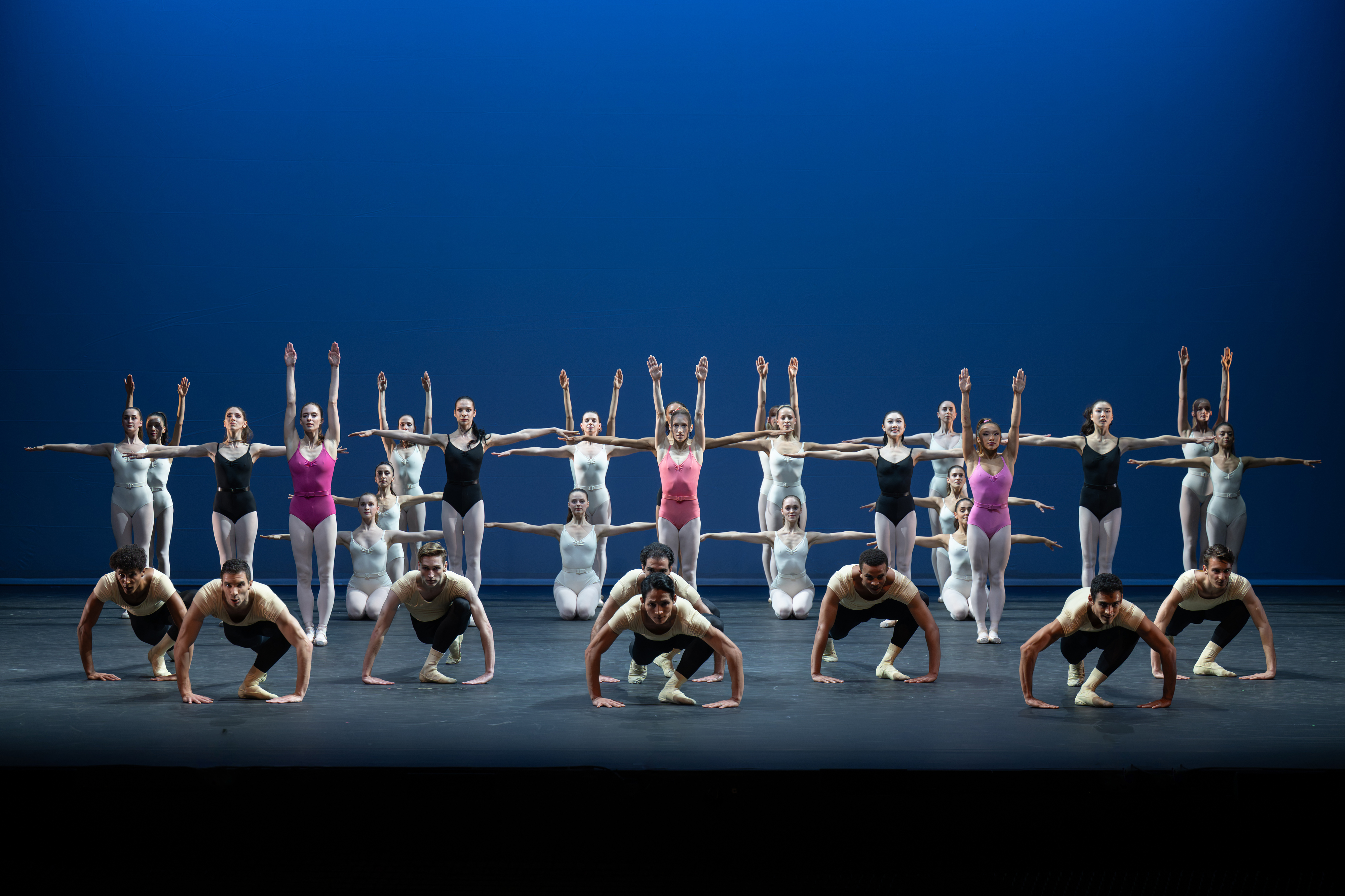
Symphony in Three Movements is a masterclass in what’s become known as Balanchine’s ‘leotard ballet’ style. Stripped of elaborate costumes and traditional storytelling, Balanchine lets the movement and the 32 dancers speak for themselves.
The choreography mirrors Stravinsky’s propulsive rhythms and angular jazz influences move for move, filled with brisk, athletic walks, turned-in positions, and intricate group formations that send bold energy across the stage.
True to its title, the ballet unfolds in three distinct movements that mirror the music itself. With no scenic backdrop or narrative to lean on, the piece leaves nowhere to hide: just Balanchine’s choreography, in all its complexity, front and centre.
Choreographers combine movements, and the ones I arranged for this music follow no story line or narrative. They try to catch the music and do not, I hope, lean on it, using it instead for support and time frame. – George Balanchine
Keep an ear out for a score, played live by English National Ballet Philharmonic, that refuses to sit in one genre – classical strings, jazz horns and drums, all filtered through one orchestral language.
We’re performing Symphony in Three Movements as part of Rhythm Riot at Sadler’s Wells, 24 Sept – 3 Oct. This performance will be danced alongside two world premieres; Jae Man Joo’s Auguries of Innocence and Micaela Taylor’s Bow Out. Book your tickets.
Related news


Auguries of Innocence: Everything to know about Jae Man Joo’s world premiere
Ahead of opening night, discover the inspiration, artistry and emotion behind Auguries of Innocence.


Introducing Micaela Taylor
Aaron S. Watkin talks about the LA-based choreographer and the essence of her new work, Bow Out.

5 things to look out for in Bow Out
Fresh, bold, and full of infectious energy - here are 5 things to watch out for in Bow Out by...