Pause and… Re-Play 2026!
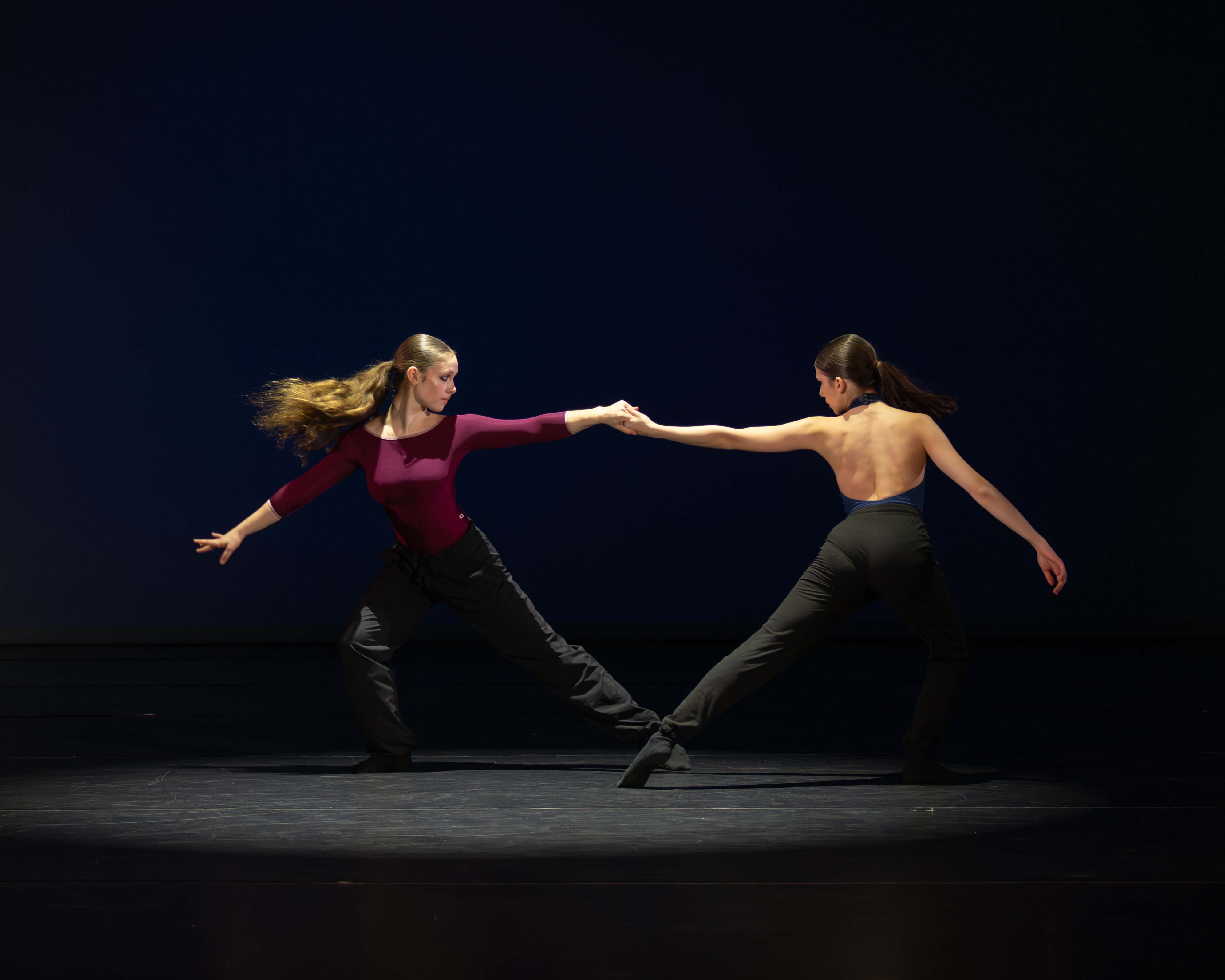
In March we hosted Re-Play, an annual platform showcasing some of the inspiring initiatives run by our Engagement team. This year’s event at Mulryan Centre for Dance included performances from ENBYouthCo and ENBParkinson’sCo, as well as a guest performance from East London Youth Dance Company, Artists of the Company and English National Ballet School.
ENBYouthCo participant Pearl Isaacs, said:
I really enjoyed seeing everyone’s pieces and seeing different ages and types of people come together and perform. I thought it was really special.
Lola-May, a writer who works with People Dancing, the foundation for community dance, reflects on the performances.
John William–Watson, ENBYouthCo: Something Completely Different
This was an absurd and chaotic exploration of what happens when a talk show ends, and the credits roll…
“John has a very unique style,” said ENBYouthCo dancer, Arlo Woodfield, “His piece breaks a lot of barriers in dance. We got to bridge different artforms through combining comedy, acting and even features like breaking the fourth wall and interacting with the audience. Those are things you don’t often get handed as a dancer, so it was a really nice opportunity to experiment with that”.
“I thought it was really inspiring working with someone with such an established style of their own, who invited us into that style and to collaborate,” said youth dancer Carys Barker. The nuanced, eccentric piece toyed with playing around with the unknown, and was a fun and engaging opening act.
ENBParkinson’sCo: The Gift
This piece by ENBParkinson’sCo was inspired by the phrase “together in oneness,” and the work was a celebration of the unique artists living with Parkinson’s who make up the powerful collective. “If someone is struggling with anything, we help each other along,” Maggie Hollingsworth, a Dance for Parkinson’s performer said, “it’s been a real lesson in group dynamic and group support”.
Trust, understanding and group support sit firmly at the core of the group’s work, and through dance, they find control, unity and community.
According to The National Institute of Health, “Evidence from qualitative studies has indicated that the majority of participants experiencing community-based exercise dance programmes find them helpful in relation to regaining a sense of positive identity after a diagnosis of Parkinson’s”.
Many participants experience decreased feelings of isolation, better mood and quality of life, reduced motor symptoms, and enhanced functioning. “Parkinson’s makes you very emotional, one way or another, you are either up or you’re down,” Maggie explains, “but when you’re dancing on stage, and things go right, it’s the most wonderful feeling.”
The piece was both raw and heartfelt, and you could see the dancers use gestures as a tool for expression and as a playground for imaginative transformation.

Martinho Santos, English National Ballet Artist: Against the Pulse
Martinho Santos is an English National Ballet company dancer, as well as a musician and choreographer. “As a choreographer, the movement and the language you use is also inspired by your work as a dancer and working with different choreographers. A big part of creating is how your vocabulary and the world you’re creating, fits with the dancer you are working with.”
Santos’ work, ‘Against the Pulse’, created for dancer Tara Millard, also an Artist with English National Ballet, focuses on the relentlessness and frustration that can occur when we lose control of our lives.
“It’s a life-changing experience for a dancer to be on the other side, because you can see things from outside,” Martinho explains. The piece explored the involuntary ways anxiety consumes the body. Tara explained, “It’s been a journey, finalising the piece and changing things around, so I feel like this evening it really came together, and it felt great to dance”.

Levan Peart: Jungle Boy
Levan Peart’s ‘Jungle Boy’ was created through the artist development programme Shared Ground, run by English National Ballet. This provides free studio space, themed Ideas Incubator Labs, and mentorship to independent dance artists and choreographers based in East London.
“Equitable visibility for artists comes from everyday encounters,” Levan said, “being able to share and exchange knowledge, being empathetic to understand others’ experiences and being able to open up doors for those who aren’t able to access opportunities.”
Shared Ground encapsulates these themes by bringing artists together to develop their practice through creative exchange and through accessible space and resources. “Information sharing and connections within communities are crucial to steer things forward,” Levan said.
Through the programme, Levan was able to collaborate with saxophonist and composer Charlotte Harding. “This was the first time I’ve worked with a composer, which was such a pivotal moment in my choreographic journey. I had access to resources I had never had before; it felt like a magical journey.”
Jungle Boy was a fierce performance exploring themes of mental well-being, community and identity. “Space was held for me to enter somewhere that previously I would not have had access to, and I was able to share my vision with new artists to create meaningful work,” says Levan.
The immersive performance invited the audience to reflect on society and to ‘unmask’ through a dynamic sensory experience with live music. “All in all, the programme has done an incredible job of opening up its doors to people like me,” Levan concluded.
English National Ballet School: Encounters
Four first year students from English National Ballet School came together to collaborate, negotiating their different artistic styles and thoughts to create a final piece, ‘Encounters’. “We tried to blend all four of our ideas together,” said Harper Ewert, one of the choreographers, “I think the dance represents all of us.”
The piece explored the fleeting moments when lives cross paths and unexpected connections are formed, quietly shaping who we become. “I’m really proud of what we created,” she went on to say. “It was amazing to see what we created on stage and to know that we had an impact.”
The piece reflects the beauty and unpredictability of the relationships that drift into our lives.

East London Youth Dance Company: Unified
Rooted in the community, East London Youth Dance Company is a pioneering voice in the dance scene in east London, providing inclusive dance experiences and training for all ages.
“Dance is a universal language. Everyone understands dance, and I feel like it is the easiest way for me to communicate,” said Ashanti S, a young performer from the group. “This dance is about strength and fighting, and about how everyone goes through their struggles in life, and I was able to put my own strength into the piece.”
The work, inspired by youth culture, community and self-expression, celebrates individuality with strong group identity. The choreography highlighted teamwork, resilience and the joy of expressing emotion through movement. Ashanti said: “To be able to express myself through movement is a blessing and that is something I will be taking away from this experience today.”
Re-Play 2026 served as a diverse and engaging platform for artists, choreographers and musicians from all ages and backgrounds to come together in a shared love for the arts and movement.
“I thought the performances were amazing,” said audience member Polina Zelmanova, “I loved how all the pieces were super different, and how there were echoes of conventional ballet with some more modern contemporary elements.”
Audience member Andrea Rose shared, “It was really exciting to see such a range of styles and people in different stages in their career, and it was really inspiring.”
The event united community and performance groups and showcased creative collaborations between musicians and choreographers, to reflect the plurality and creativity found and fostered in east London by English National Ballet.
Related news
Taking centre stage: Preview to Re-Play 2025
English National Ballet’s exciting annual performance platform returns this March.